


Zones Explained: Why Location Impacts Everything in Tycoon Online


When I first started playing Tycoon Online, I assumed zones were just empty spaces where buildings could be placed. As long as I had enough land, I thought everything would work fine.
After playing for a while, I realised the system is much deeper than that.
Zones are not just empty land.
They determine where your business can operate, how efficiently your production chains work, and how easily your company can expand.
Understanding the zone system early can prevent many beginner mistakes.
The City Map Is Divided Into Different Areas

When I explored the city map for the first time, I noticed that the city is divided into different types of areas.
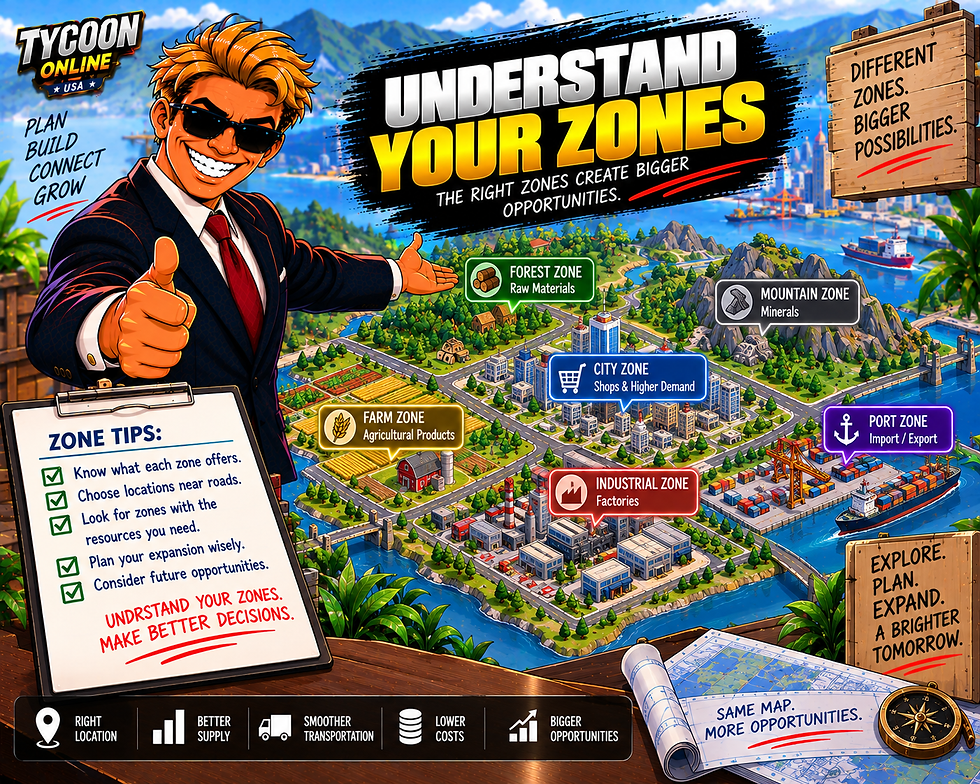
There are three main zone types:
Offshore (blue)
Countryside (light green)
Downtown (grey)
Each zone represents a different part of the city’s economy. When you zoom in on the map, you can see many individual zones that can be purchased or that are already owned by other companies.
Every building in the game must be placed in these zones.
Buildings Require Specific Zone Types

One thing I didn’t realise at the beginning is that not every building can be placed everywhere.
Each building has its own zone requirements.
For example:
Many production and raw material facilities require Countryside zones
Many shops and service businesses require Downtown zones
If you buy zones in the wrong part of the city, you may find that the building you want to construct cannot be placed there at all.
Because buildings also cannot be rotated, choosing the correct zones before purchasing land becomes an important strategy.
The First Zones Are Free — But Expansion Gets Expensive
When you start a new company, the game gives you the first ten zones for free.
After that, additional zones must be purchased, and their prices gradually increase.
This means zone purchases become an important financial decision as your company grows.
If you accidentally buy zones you cannot use, you can still sell them back to the bank, but you will only receive half of the original purchase price.
Roadside Locations Provide a Production Bonus

Another interesting detail about zones is the roadside bonus.
If at least one part of a building touches a road, that building receives a 30% production bonus.
This bonus can significantly increase output, which makes roadside zones highly desirable.
However, buildings can still operate without this bonus. Many players build wherever space is available first and later relocate buildings to better roadside locations when possible.
New Areas of the City Open Over Time
At the beginning of a game round, only part of the city is available.
As players purchase more zones and expand their businesses, new sections of the city gradually open.
For example:
A new Countryside section opens when available countryside zones drop below 60%
A new Downtown section opens when available downtown zones drop below 35%
This means the city expands naturally as companies grow.
The Biggest Lesson I Learned

At first, I thought Tycoon Online was mainly about building factories and producing goods.
But after understanding the zone system, I realised that location is part of the strategy.
Zones determine:
where buildings can be placed
how production chains are organised
when new areas of the city unlock
whether buildings receive production bonuses
Once I started paying attention to zones, my business decisions in the game became much clearer.
Final Thoughts
Tycoon Online might look simple at first, but the map and zone system add an important strategic layer to the game.
Buildings produce goods.
Markets determine prices.
But zones determine how your company can grow.
Understanding how the city map works is one of the first steps toward building a more efficient business in Tycoon Online.


Comments