


Tycoon Online for Teachers: A Free Browser-Based Business Simulation for the Classroom


If you teach business, economics, or enterprise, and you've been hunting for a simulation game your students can actually run with — one that's free, lives in the browser, and doesn't need a single installation on a locked-down school network — Tycoon Online is worth a serious look.
It's a long-running multiplayer business simulation where players build companies from scratch: factories produce goods, shops sell them, offices run marketing campaigns, warehouses move stock, and a real player-driven market sets the prices. Students raise loans, hire staff, buy and sell shares, and compete (or cooperate) with other players for market share. Given half an hour a week, it quietly teaches concepts that take a textbook chapter to explain.
Why it works in a classroom

The mechanics map directly onto the curriculum. Pricing decisions teach supply and demand because the market is real — set your price too high and your shop sits empty; too low and you sell out before lunch. Hiring staff and managing wages teaches HR and labour costs. Taking out a loan teaches gearing and repayment schedules. Buying shares in a competitor's company teaches valuation and risk. None of this is dressed up as a lesson — it just happens, because the game is built on the same logic real businesses run on.
It also teaches something harder to get from a worksheet: patience. Tycoon Online runs in real time. A factory takes hours to produce its goods; a marketing campaign takes days to pay back. Students who treat it like a clicker game don't get far. Students who plan, project, and reinvest do. That gap is itself the lesson.
Curriculum hooks
Whether you're teaching UK GCSE Business, BTEC Business, A-Level Economics, IB Business Management, or a US high school Economics or Personal Finance course, the touchpoints are immediate:
Microeconomics — market clearing, elasticity, competition
Business operations — production, inventory, supply chains
Finance and accounting — balance sheets, loans, share issuance, cash flow
Marketing — targeted campaigns, advertising spend vs return
Strategy and enterprise — differentiation, scaling, exit decisions
Most teachers find the game naturally slots into a unit on competitive markets or business operations — but it's flexible enough to support a year-long enrichment thread, too.
Four lesson ideas to start with

The pricing experiment. Each student opens a single shop selling the same product. Over a week, they experiment with pricing strategy and report back with sales data. Class discussion: who priced for volume, who priced for margin, who got it right?
The startup challenge. In teams, students start with the same modest savings. After three weeks, the team with the highest net worth presents what they did and why. Bonus marks for justifying decisions in proper business language.
The crash analysis. Look at the in-game economy charts together. Identify a price spike or crash on a real product, and ask students to reverse-engineer what caused it. Real economics, real data, no hypothetical scenarios.
The hiring decision. Students write the recruitment ad for a key staff hire in their company, then defend the hiring choice to the class. Combines HR theory with persuasive writing.
Getting your class set up
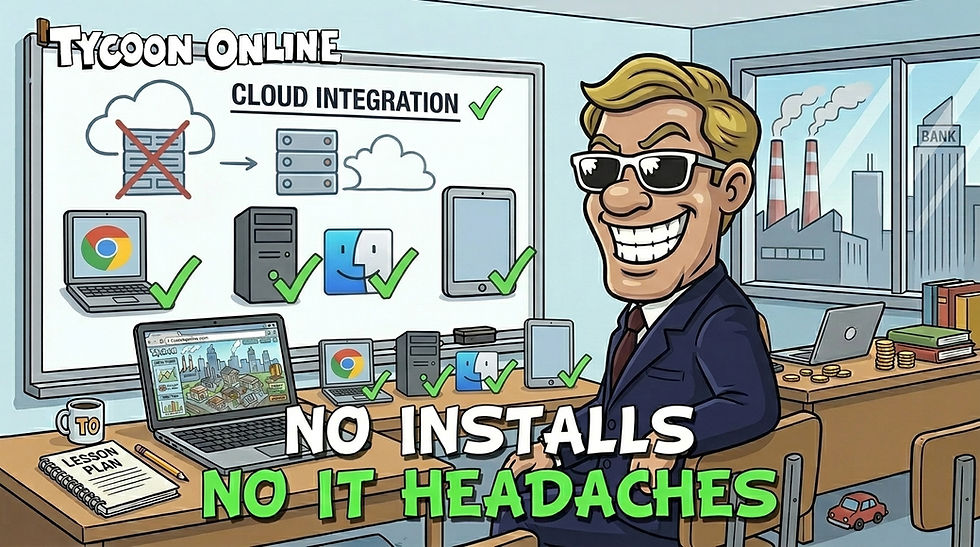
Each student creates their own free account at tycoononline.com. There's no class licence to buy, no software to install, and it works on Chromebooks, Macs, PCs, and tablets — anything with a modern browser. You can let students choose their own usernames or assign them if you'd rather keep things tidy.
A reasonable rhythm is 20 to 30 minutes of in-class time per week, plus encouragement to log in for short check-ins from home. The real-time element means students who engage between lessons will outperform those who don't — which is, again, a useful real-world parallel.
A few honest answers
Is it really free? Yes. There's an optional paid Gold membership that adds quality-of-life features, but everything needed to play, compete, and win is free. Students don't need to spend anything.
Will it run on the school network? It's a browser-based site with no plugins or downloads and modest bandwidth requirements. If your network allows general web traffic, it'll run.
Is it appropriate for my age group? The game is best suited to students aged 16 and above. Younger classes are possible with closer supervision, particularly in the in-game chat and forums, where students will interact with the wider adult player base. If you're planning to use it with under-16s, get in touch with us first — we can advise on safer setup options.
How much prep do I need? Once you've played for a few hours yourself, you'll have enough to guide a class. There's an in-game Help section and a friendly forum community happy to answer beginner questions.
Bring it into your classroom
If you'd like a teacher's starter guide, sample lesson outlines, or a hand setting up your class, get in touch — we're always pleased to hear from educators thinking about how to bring the game into their teaching.
Comments